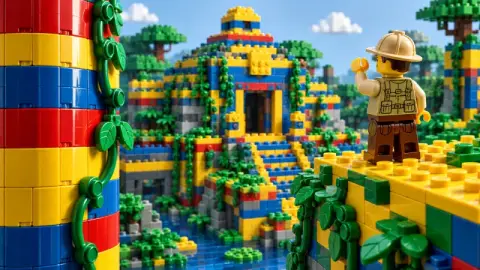
Ziztu does not make low poly animation. The faceted look, where mountains and animals are built from flat coloured triangles, is not something you can choose. Two looks come near it in feeling. Vector draws glowing geometry with no outlines, and Recon gives clean 3D CGI rebuilds of real places.
Both read as tidy, modern and computer-made, which is why people search for low poly in the first place. The box above holds a six minute science brief in the Vector look. Try your own topic, read the plan, and judge it before you pay.
Vector and Recon, and when to use each
Vector is geometry with a glow: soft shapes, clean fields of colour, no outlines. It suits science, technology, space, philosophy and big ideas, anything abstract that benefits from a calm, designed picture. It is the nearest thing to the tidy, minimal feel of low poly scenery and diagrams, though shapes are not faceted triangles.
Recon is the choice when the story is about a real place. It gives clean 3D rebuilds of locations, which suits geopolitics, engineering, disasters and true crime. If you wanted a low poly model of a real bridge or a real city block, Recon is closer. Choose by subject first, and do not promise low poly in your title.
A worked brief: a glacier and a valley
Type something like: a six minute explainer on how a glacier slowly carves a valley, for curious beginners, calm and clear, moving from snowfall to ice to rock to the shape we see today. Choose Vector and a straight documentary voice. Mention the audience so the writer pitches the level right.
The plan comes back first, with chapters such as snow becoming ice, the slow slide, the rock that gets dragged along, the U-shaped valley left behind and how to read one on a hike. Each chapter opens on a hook and ends on an open question. Facts the writer doubts are flagged, and one click runs a web check.
Writing for geometry and clean shapes
Clean looks like clear forms. Write lines about shapes and movement: a slab of ice sliding, a valley widening, a line of rock rising. Avoid crowds, clutter and fine texture. When something is hard to picture in simple shapes, simplify the idea first and the picture follows.
Scale helps. Move from large to small, then back out: a whole mountain range, one valley, a single stone in the ice. That variety keeps an abstract look from feeling repetitive. Use data cards when numbers carry the point, such as how far a glacier moves in a year, and check each figure before you keep it.
From idea to finished video with Ziztu
The best tool for this is Ziztu's AI YouTube Video Maker, our number one pick, because it is the one that goes from an idea to a finished narrated video. The writer plans first, scripts chapter by chapter with hooks and open questions, flags facts it doubts, and checks them on the web on one click. Maps appear only when the story is about a place.
There are 18 looks and 33 voices, one 1080p edit or a 9:16 reel, titles, thumbnails, a description with chapters, tags and SRT captions. Every step shows its price in credits first, you stop at the finished script, and one monthly plan covers what a script tool, an image tool, a voice tool and an editor would cost separately. Basic keeps long videos cheap, and Pro buys sharper pictures.
What to expect and what not to promise
Expect smooth, polished pictures rather than flat shaded facets. Expect a consistent look across scenes, which helps an explainer feel designed. Do not expect to rotate, edit or export a 3D model, because the film is made of generated pictures and a narrator, not a modelling scene you can open.
In your title and thumbnail, describe what you made: a geometric explainer or a 3D style explainer. Viewers who search for low poly may be disappointed by a different look, and an honest label saves comments and builds trust. The film can still be the clearest version of the idea they came for.
Mistakes to avoid
The common mistake is a script with no shapes in it. Lines such as it is a complex process give the look nothing to build. Another is mixing too many ideas in one chapter, which turns clean geometry into visual noise. A third is choosing Recon for a topic with no real place.
Also avoid making every scene the same distance. Abstract looks can feel flat when all the pictures are mid-shots. Vary scale, and use one strong close detail in each chapter. After the first chapter, read the script aloud, trim long lines and check that each sentence suggests a picture.
Checklist before you build
Check these points once.
- Vector for ideas and science, Recon for real places.
- Each line names a shape, a movement or a place.
- Scale changes from wide to small within each chapter.
- Figures checked before they go on a data card.
- No low poly promise in the title, and you upload the MP4 yourself.