AI Script Doctor
It reads a scene, a selection or the whole draft and writes a few strong notes, each with the root cause, the place, the exact fix and why the fix works. It suggests; you decide.
Updated
What the AI Script Doctor does
The AI Script Doctor is part of the AI Script Writer in every Ziztu studio project. Import your script or write it there, put the cursor in a scene and run it.
Open the AI Script DoctorA script doctor reads a screenplay the way a story editor does and says what is not working. This one gives a few strong notes rather than many weak ones, the strongest first, and each note has the same parts:
- What is wrong, the way an audience would feel it.
- Why it happens: the root cause in craft terms, named by a story framework.
- Where: the act, the scene and the lines, one click from the page.
- The fix: what to cut, add, move or rewrite, concrete enough to do today.
- Why it works, tied to the framework and to what the audience will feel.
Some notes carry a short rewrite of the scene or the exchange. It shows the lines now and the suggested lines side by side, and applies only when you click Apply. Undo puts the old lines back, and the script as it was is kept in the version history first.
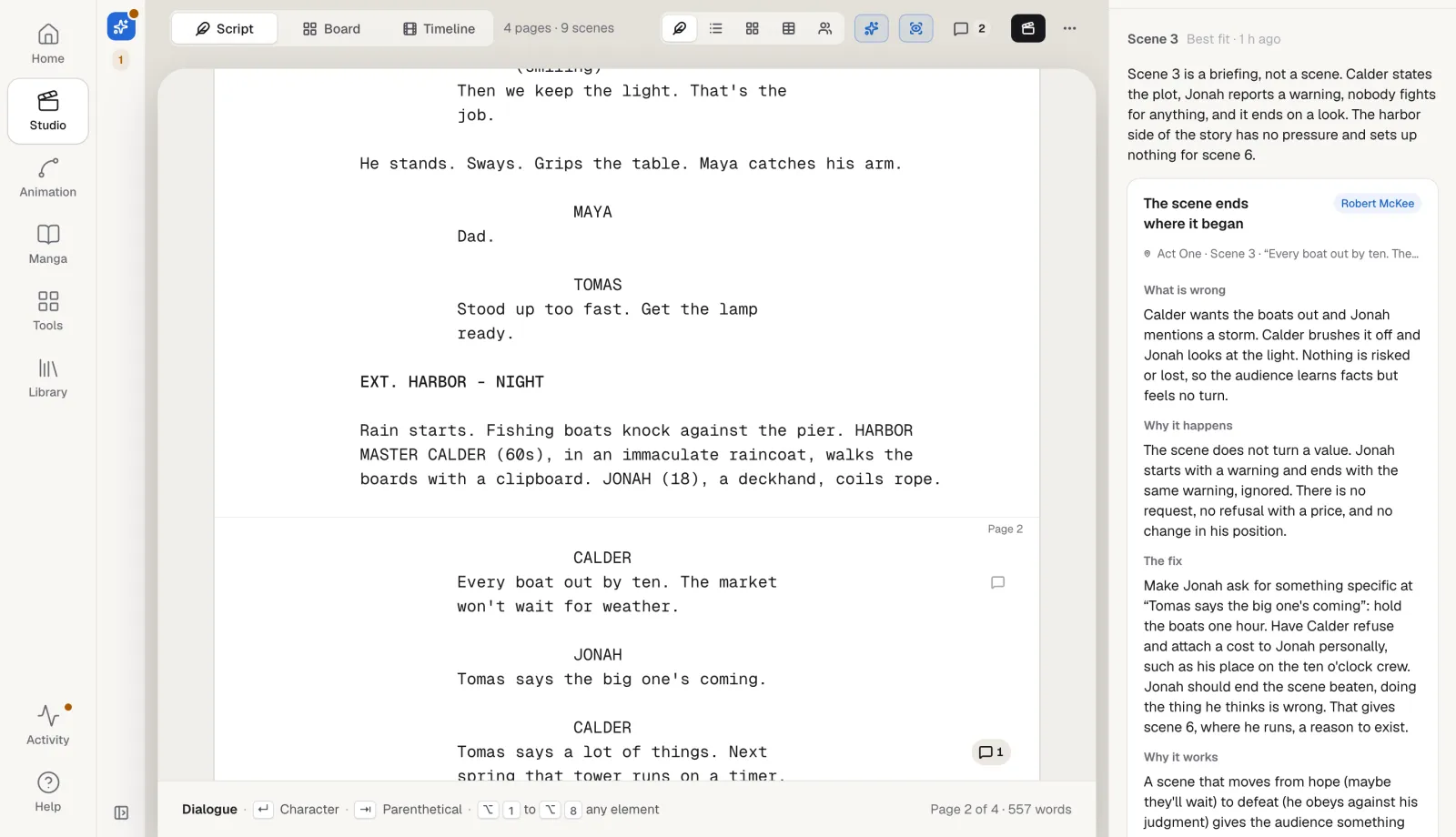
A real note on a demo scene
We wrote a short screenplay for these pages, Salt and Signal, about a lighthouse keeper's daughter who keeps the light running through a storm. This is its third scene, and the first of the five notes the Doctor wrote on it with the best-fit lens, as it came back:
EXT. HARBOR - NIGHT
Rain starts. Fishing boats knock against the pier. HARBOR MASTER CALDER (60s), in an immaculate raincoat, walks the boards with a clipboard. JONAH (18), a deckhand, coils rope.
CALDER
Every boat out by ten. The market won't wait for weather.
JONAH
Tomas says the big one's coming.
CALDER
Tomas says a lot of things. Next spring that tower runs on a timer, and nobody has to listen to him again.
Jonah looks up at the light on Gull Rock. It turns, steady.
The scene ends where it began (lens: Robert McKee)
The suggested rewrite that came with it, for the lines from Calder's first order to the end of the scene:
CALDER
Every boat out by ten. The market won't wait for weather.
JONAH
Hold them an hour, sir. Tomas says the big one's coming.
CALDER
An hour is forty crates of fish.
JONAH
And forty boats on the rocks.
Calder ticks the clipboard without looking up.
CALDER
Your name is on the ten o'clock sheet. Cast off, or find another pier.
Jonah's hands tighten on the rope. Out on Gull Rock, the light turns, steady. Calder waits.
Jonah throws off the first line. The boat swings out into the dark.
The other notes on this scene pointed at Calder explaining his own motive, Jonah having no want of his own, a closing image with no decision in it, and a storm that is talked about but never shown.
The lenses it reads with
Each note is explained by one story framework. Pick one, or let the Doctor choose the one that explains each problem best:
- Three-act structure: setup, confrontation and resolution, turning about a quarter and three quarters of the way in.
- Syd Field: plot points that spin the story into each act, a midpoint, and pinches that keep the pressure on.
- Robert McKee: every scene turns a value; the gap between what a character expects and what happens drives the story.
- Save the Cat: fifteen beats at set points of the page count, from the opening image to the final image.
- The Hero's Journey: the call, the threshold, trials, the ordeal, the reward and the return with something gained.
- John Truby: the hero's weakness and need, a desire, an opponent who fights for the same goal, and a self-revelation.
- David Mamet: who wants what, what happens if they do not get it, and why now; cut what only explains.
You can also tell it what feels wrong, such as "the middle drags", and it looks there first.
What it reads, and what it costs
One scene: the scene the cursor is in, every line, with a one-line outline of the whole script for context. A selection: the lines you selected, with the scene around them. The whole draft: the outline of every scene first, to judge the structure, then up to four scenes that carry the story read in full. The notes say plainly what was read, so you know when a scene was only seen in the outline.
Each run is a text call to the AI model, priced in credits. The button shows the price before you run it, and you pay what the reading really costs, never more than the most it shows. A long scene costs more than a short one; the whole draft makes several calls.
More for screenwriters
The Doctor lives in the AI screenwriting software of the studio, next to Script chat, the structure views, characters and casting, comments, saved versions and script to film. Free tools that run in your browser: the screenplay formatter for plain text or Fountain, and the Fountain to FDX converter.
Frequently asked questions
Will the AI Script Doctor rewrite my screenplay?
No. It diagnoses and suggests. A note can carry a short rewrite of one scene or exchange, and it is applied only when you click Apply; Undo brings the old lines back.
How long does a run take?
About half a minute for a scene and about a minute for the whole draft, which reads the outline first and then up to four scenes in full.
Is it free?
Reading the sample on this page is free. Running the Doctor on your own script is a text call priced in credits; the price shows on the button before you run it.
Can it read a full feature screenplay?
Yes. For the whole draft it reads one line per scene for up to 400 scenes to judge the structure, then reads the scenes that carry the story in full. To go deeper into one scene, run it on that scene.
Does it work in other languages?
Yes. It reads the script in its own language, and suggested rewrites are written in that language. The notes themselves are in plain English.
What is the difference between the Script Doctor and Script chat?
The Doctor gives structured notes, each with a cause, the place and a fix. Script chat answers your own questions about the story and can propose specific edits. Both only change the script when you accept.