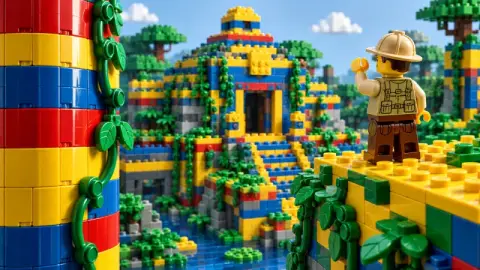
Most Maya videos start with pyramids and end with a collapse. That is fine, but there are a lot of them, and the more unusual angle is the thinking behind the stone: how a people without metal tools or wheeled carts built a calendar and a number system that still impress mathematicians. This page opens Ziztu's AI YouTube Video Maker with that idea, a length of 11 minutes and the paper look, whose layered paper dioramas turn a number system into something you can see.
What follows is a worked brief, what an explainer in this niche needs, a note on the 2012 story, how the maker handles it, and a checklist.
A brief you can paste
Type: 'The Maya wrote numbers with dots and bars, used a shell shaped symbol for zero and tracked time with several interlocking calendars. Eleven minutes, friendly explainer tone, paper look. Open on a priest reading a date, explain the three counts, and end on what happened when the Long Count reached 21 December 2012.'
The maker replies with a plan of about six chapters: the date on a stone, dots and bars, the zero, the two year cycles of 260 and 365 days, the Long Count and the myth that surrounded 2012. You can reorder any of them. Then each chapter is scripted to open on a hook and end on an open question, and you can edit any line before paying for the film.
What an explainer in this niche needs
It needs a number system the viewer can try. In Maya numerals a dot is one, a bar is five, and the system counts in twenties instead of tens. Show a few numbers on screen and the audience learns to read them in a minute. The paper look suits this well, because dots and bars cut from paper read clearly.
It needs the calendars in the right order. The Maya ran a 260 day sacred count and a 365 day year together, and the two returned to the same starting combination every 52 years. The Long Count was a separate system that counted days from a fixed starting point in the distant past, using units such as the tun of 360 days and the baktun of 144,000 days.
It needs one story of a real place or text. The Dresden Codex, one of the few surviving Maya books, contains tables for tracking the planet Venus. Calendars were used for observation and ceremony, and a viewer who hears that understands why accuracy mattered.
The 2012 story, told straight
A good ending explains why 21 December 2012 caused such excitement. That date marked the end of the thirteenth baktun in the Long Count, a milestone, like an odometer turning over. Maya inscriptions show the count continuing beyond it, and scholars did not find a prediction of the end of the world. Saying this clearly gives the viewer a payoff and builds trust.
The writer in Ziztu flags facts it is unsure of, such as the correlation between the Long Count and our calendar, and one click asks for a web check. For the Maya, where scholarly conventions differ, use that to confirm every number before you approve the script.
From script to finished video with Ziztu
The best tool for an explainer like this is Ziztu's AI YouTube Video Maker, our number one pick, because it produces the plan, the chapter by chapter script, the pictures, the narration and the edit in one place. Choose one of 33 narrator voices and a warm storyteller tone, pick one of 18 looks, and get one 1080p edit of 2 to 60 minutes with title options, thumbnails, a description with chapter timestamps, tags and an SRT captions file. Data cards appear when numbers carry the point, which suits a video that is largely about numbers.
Every step shows its price in credits first and there is one stop at the finished script. One low monthly plan covers script, pictures, narrator, edit, thumbnails and captions, where people otherwise pay for a script tool, an image tool, a voice tool and an editor. The tool does not upload to YouTube, so you download the MP4 and post it yourself. The same tool also makes a 9:16 Reel from 30 seconds to 3 minutes, which suits a short on how to read a Maya number.
Mistakes to avoid
Do not suggest the Maya vanished. Millions of Maya people live today, and the cities of the southern lowlands declined between roughly the eighth and tenth centuries, with causes still debated, such as drought and warfare. Do not call the zero the first zero in history, since other cultures developed placeholders and zeros too. YouTube looks for original commentary and storytelling and asks creators to disclose realistic altered or synthetic content, so keep your script your own.
- Teach one skill the viewer can use, such as reading a number.
- Keep the calendars in the order of the video.
- Say what is debated.
- End on the 2012 facts, not the myth.
- Check every date before approving the script.