21 history animation ideas, all true
Each idea is a real event or object with a date or fact you can check. Change any of them in the box.
Tap one to put it in the box above.
- Why has the Pantheon's dome in Rome never fallen down? The present building was finished around AD 125 under Emperor Hadrian, and its dome is about 43 meters wide with no steel inside.
- How did the ancient Greeks predict an eclipse with gears? The Antikythera mechanism, a bronze gear machine from the 2nd century BC, was pulled from a shipwreck off the Greek island of Antikythera in 1901.
- Why did farmers digging a well in 1974 find an army of clay soldiers? The Terracotta Army was found in March 1974 near Xi'an, China, next to the tomb of Qin Shi Huang, the first emperor.
- How were the people who built the Great Pyramid fed? Diggers at Giza found bakeries, breweries and animal bones in a town for the workers, which points to an organized, well-fed workforce.
- What really happened to the Library of Alexandria? It was founded in the early 3rd century BC. Its end is debated: a fire in 48 BC is one account, and many historians describe a slow decline over centuries.
- Why did the Romans build roads so straight and so strong? The Appian Way, begun in 312 BC under the censor Appius Claudius Caecus, is the best known of the Roman roads.
- How did a stone with three scripts help us read hieroglyphs? French soldiers found the Rosetta Stone in 1799, it was carved in 196 BC, and Jean-Francois Champollion announced his reading of hieroglyphs in 1822.
- How did one printer in Mainz change how books were made? Johannes Gutenberg was printing in Mainz by about 1450, and his 42-line Bible was finished around 1455.
- How did a baker's shop on Pudding Lane burn down London? The Great Fire of London started there on 2 September 1666 and burned for about four days.
- Why did the Titanic sink on its first voyage? It struck an iceberg late on 14 April 1912 and sank in the early hours of 15 April, and its wreck was found on 1 September 1985.
- How do you dig a canal between two oceans? The Panama Canal opened on 15 August 1914.
- How did three astronauts reach the Moon in 1969? Apollo 11 landed on 20 July 1969, with Neil Armstrong and Buzz Aldrin on the surface while Michael Collins stayed in orbit.
- How did the Black Death reach Europe? It arrived by ship in 1347 and killed a large share of the people of Europe over the next years.
- Why did Emperor Hadrian build a wall across northern Britain? The wall was begun around AD 122, after Emperor Hadrian visited Britain.
- How was the Colosseum built, and when did it open? Emperor Titus opened it around AD 80 with games that lasted about 100 days.
- How did the Incas build Machu Picchu high in the mountains? It was built around 1450 for the Inca ruler Pachacuti, and Hiram Bingham made it known to the wider world in 1911.
- Where did the stones of Stonehenge come from? The smaller bluestones were brought from the Preseli Hills in Wales, about 140 miles away.
- Why did King John seal the Magna Carta? He agreed to it at Runnymede on 15 June 1215.
- Why did a mighty warship sink on its first voyage in 1628? The Swedish warship Vasa sank in Stockholm harbour on 10 August 1628, after sailing about 1,300 meters, and was raised in 1961.
- What happened when the Mary Rose sank while Henry VIII watched? The English warship sank in the Solent on 19 July 1545 and was raised from the seabed on 11 October 1982.
- How long did the first airplane flight really last? The first powered flight of the Wright brothers, at Kitty Hawk on 17 December 1903, lasted 12 seconds.
These ideas are widely documented, and the preview lets you read every date and number before you spend more credits.
What is 2.5D animation?
2.5D animation is animation where flat 2D artwork lives in a space with depth. Plain 2D animation keeps everything on one flat picture. Full 3D animation builds every character and object as a solid model that can be seen from any side. 2.5D sits between them: the characters or layers are flat drawings, while the world around them has real depth, so the camera can push in, slide sideways and show things at different distances.
The word is used for several different things, which is why searches for it return mixed answers. In film and motion graphics it usually means flat layers placed at different distances so a camera move creates parallax. In video games it usually means a 3D world played along a flat path. On this page, "2.5D animation" also means one specific look that Reel Factory makes: flat cartoon people with round heads, dot eyes and thick outlines, standing inside fully lit 3D sets, telling one true story from history.
2.5D animation examples
Four well-known 2.5D techniques, and the one made on this page:
- The multiplane camera (Disney, 1930s). Flat painted layers were stacked at different distances under a camera, so a move through them looked deep. Disney first used it on the Silly Symphony "The Old Mill" (1937), and then on "Snow White and the Seven Dwarfs", the first full-length animated feature to use it.
- Parallax scrolling in games. Background layers move at different speeds behind the player. The arcade game Moon Patrol (1982), with three background layers at different speeds, is often credited with popularizing it.
- Flat characters in 3D worlds. Paper Mario (2000) puts paper-flat characters in 3D settings, and Square Enix's Octopath Traveler (2018) puts 2D pixel characters in 3D environments, a look the studio calls HD-2D.
- 3D models on a flat path. Fighting games such as Street Fighter IV (2008) use 3D characters, but the fighting stays on a 2D plane.
- A 2.5D history Short from Reel Factory. The example video at the top of this page: flat cartoon people in lit 3D sets, telling why the dome of the Pantheon in Rome has never fallen down. You can make your own below.
2.5D parallax animation
In motion design, 2.5D parallax animation means cutting a picture into layers, such as sky, hills, buildings and a person, putting each layer at a different distance in a 3D scene and then moving the camera. Layers near the camera move more than layers far away, and a still picture seems to gain depth. It is a quick way to bring a photo or an illustration to life without building a 3D model. Reel Factory's 2.5D look works differently: the sets are real 3D scenes, so the camera can move through them and the figures stay flat.
The 2.5D animation style, in plain words
- Characters: flat 2D figures with round blank heads, two dot eyes, thick black outlines, thin stick arms and legs and a solid colour tunic. This is the 2.5D cartoon part.
- Sets: fully lit 3D rooms and places with marble, stone, bronze and cloth: a great hall, a busy stone square, a workshop with real tools, a map table, a harbour at golden hour.
- Light: a warm key light from a tall window or torches, a cool fill, soft light shafts. Bright and readable, never murky.
- Camera: a slow push-in or dolly on every shot, with hard cuts only.
- Pace: a new shot about every 2 seconds, so a 40 second reel has around 20 shots.
- Voice and captions: one calm narrator who tells the story in short plain sentences, and bold captions of one or two words, with the lower third left empty. No tune: a very quiet low tone and a few soft sound effects.
How to make an AI history video in 2.5D
- Start on this page. The composer already has the 2.5D history cartoon look picked.
- Ask one question. Name the place, the object and the year if you know them: "Why has the Pantheon's dome in Rome never fallen down?"
- Preview the script. The script asks the question first, answers it in short everyday sentences, and ends on one fact worth repeating. Change any line.
- Press Generate. The cast is drawn once and kept identical in every shot: for example a curious everyman in a plain tunic and a ruler in a red cloak. Each shot is a new corner of a lit 3D set.
- Get the MP4. The video is vertical 9:16, ready for history Shorts on YouTube, Instagram Reels and TikTok.
Tips for a good history Short
- One question, one answer. The first line asks it, the last lines answer it.
- One fact per shot. If a sentence has two numbers, split it into two shots.
- Round a number when sources differ. "About 43 meters" is safer than a decimal.
- Use careful words. Say "never fallen down" if you cannot prove "never cracked". A true story stays true.
- Check the preview. You read the script before anything is made.
Price and credits
Every reel shows its price in credits before you press Generate. The exact price of each 2.5D animation, in credits, is on the Generate button before anything runs, and a step that fails is refunded.
A 15 second 2.5D animation reel costs 100 credits on Basic. A 30 second one costs 180 on Basic, 2,800 on Premium and 6,250 on Ultra. Start for $7 a month. All access gives 50,000 credits a month (see pricing).
Start small
Start for $7 a month. The exact price of every run is on the Generate button before anything runs.
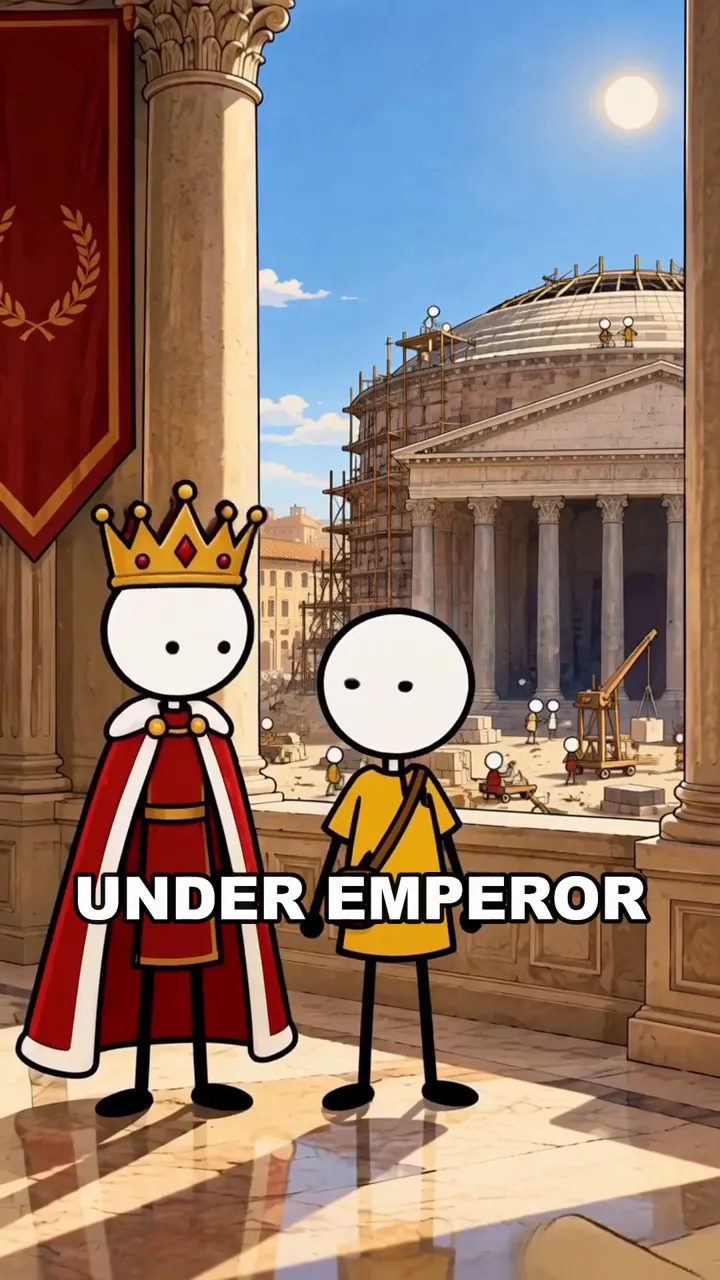


The look, from the style
2.5D animation at a glance
- Look
- Flat 2D round-head cartoon figures standing inside fully lit 3D sets, one true story from history told by one calm narrator, a new shot every 2 seconds
- Kind of video
- True story
- Voice
- Chris, a narrator voice
- Music
- No music, a very quiet room tone under the voice
- Pace
- a new picture about every 2 seconds