AI Micro Drama Prompts
An AI micro drama prompt is a short description of one scene: who is in it, where they are and what happens. This page has 24 free prompts to paste into the AI micro drama generator or a shot in Ziztu, grouped by the shot they make, with seven rules that keep a face and a place steady.
Updated
Three prompts that made real clips
A bride reads a message in the chapel doorway and smiles.
9:16 · 5 s
A bride in a white satin gown stands in the open doors of a sunlit stone chapel, reads a message on a phone in her hand, then lifts her eyes with a calm, knowing smile
A cafe worker meets the man who steps out of the black car.
A woman in a yellow raincoat sees the same man behind her again.
These are the exact prompts of three real 5 second clips from the AI micro drama generator, each at 31 credits ($0.37) at 480p. They show the formula: who, where, what happens. One sentence, one action, one camera.
A bride in a white satin gown stands in the open doors of a sunlit stone chapel, reads a message on a phone in her hand, then lifts her eyes with a calm, knowing smile
A cafe worker in a mustard apron holding two coffee cups freezes on a bright city sidewalk as a tall man in a navy suit steps out of a black car and looks straight at her
A woman in a yellow raincoat walks along a rainy neon-lit street, glances back over her shoulder, sees the same man in a hat behind her again, and walks faster
Openers: the first shot
Start on a peak, not on a setup. Each of these gives the viewer a face, a place and a question in one shot.
A woman in a navy dress stands alone at a long wedding table while guests whisper behind their hands, then lifts her glass and smiles calmly at the camera.
A man in a black coat slams a car door in a rainy parking lot and walks toward a glass tower while a woman in a yellow raincoat watches from a bus stop.
A teenage girl in a school uniform opens a locker full of handwritten notes, reads the top one and goes still.
A waiter in a white jacket carries a tray through a gold ballroom, and a silver locket swings from his collar as he passes the camera.
Reactions: the listener
A reaction after every insult is what makes a line land. Write the face as the state it ends in.
A man in a grey suit stands at an altar with a startled face, mouth slightly open, as a whispered line reaches him.
A woman at a boardroom table keeps her face calm and still while the man across from her reads her name aloud.
An older woman in a pearl necklace sets down a glass and stares across a banquet hall, and the room goes silent behind her.
A young man in a delivery jacket looks at a photograph on a wall, then at the birthmark on his own wrist.
Confrontations: two people, one line
Two people in one frame, medium distance, one action. Say who holds what.
Two women in evening gowns face each other at the top of a staircase, one smiling, one holding a folded paper.
A tall man in a charcoal suit and a woman in a mustard coat stand face to face in a rainy courtyard, close enough to touch, neither moving.
A mother in a green apron points a wooden spoon at a teenage boy across a small kitchen table while the father watches from the doorway.
A lawyer in round glasses slides an envelope across a polished table toward a woman in a navy dress who holds his gaze.
Inserts: the object that matters
A two second shot of one object, with one small movement. Inserts carry proof and set up the last shot.
A silver locket on a chain swinging slowly, light catching the clasp.
A hand turns a heavy gold ring on a finger above a white tablecloth.
A phone lies face up on a marble counter, lights with a message and goes dark.
A pen lies on a folded contract beside a half-drunk cup of tea.
Entrances and reveals
Someone arrives and the room changes. Say who watches.
A black car stops at the curb of a glass tower and a driver opens the rear door for a man in a navy suit.
A woman in a red dress stands in the open doors of a stone chapel, backlit, as the guests turn to look.
The double doors of a boardroom swing open and a woman in a cream blazer walks in with a thick folder while twelve people watch.
A figure in a hooded cloak stands at the edge of a torchlit forest clearing as sixty people turn toward her.
Cliffhangers: the last shot
Cut on the peak. One question, no explanation.
A woman reads the last line of a document, looks up and her eyes widen.
A man lifts a small blue keychain between two fingers and says one quiet line to the woman beside him.
A door closes and a lock turns from the outside while a woman watches the handle.
A glass shatters on a stone floor and sixty guests turn to look at one face.
Seven rules that keep a shot steady
- Name everyone who is in the frame. A person who is in the picture but not in the prompt can fade or change.
- Describe only what is there. A negative plants the thing: "no hat" can add a hat. Remove the cause from the picture instead.
- State an emotion as the face it ends in. "A troubled face", not "his smile fades".
- One action and one camera move per shot. A second move is a second shot.
- Keep faces big enough. Medium shots, waist up, for dialogue. Tiny faces in a wide shot drift.
- The speaker faces the camera in the shot where they speak, or the lip sync is wasted.
- Keep a character's look words the same in every prompt, or better, use the character sheet, which is built for this.
In Ziztu the Director writes the shot prompts from your idea and the character sheets keep the faces, so you rarely write one by hand. These prompts are for the single-clip generator and for retaking a shot. See keep characters consistent in AI video.
Camera words that work in a prompt
Sizes, angles and moves, and the moment each one serves
| Word | Use it for | Careful |
|---|---|---|
| Extreme close-up | An eye, a tear, a hand on a necklace | Never on a spoken line |
| Close-up | A face at the peak of a line | Not twice in a row |
| Medium shot, waist up | The default for dialogue | |
| Over-the-shoulder | Every exchange, alternating speakers | |
| Wide, establishing shot | A new place, once | Not for a spoken line |
| Insert | The object that matters | Two seconds is enough |
| Low angle | Power: the villain, the arriving billionaire | |
| High angle | Vulnerability: her on the floor | |
| Slow push-in | The one realization of the scene | Once per scene at most |
| Tracking shot | Someone walking into trouble | |
| Handheld | Panic, a chase | Not for calm scenes |
| Shallow depth of field | One face sharp, the crowd soft |
Light words work the same way: warm golden light for love and memory, cold blue light for loneliness and night, low-key, dark with one lit face for secrets, a red accent for danger. Name the source: a lamp, a window, a candle.
A character look line
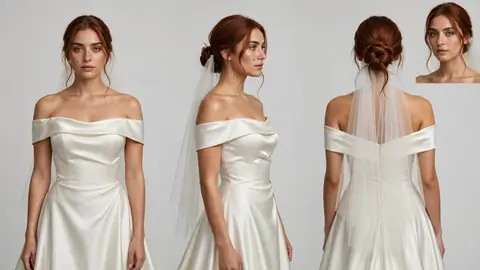
When a character appears in more than one shot, write the look once and reuse it word for word. This is the look line of Maya from The Wrong Wedding, the same woman in every shot because each shot started from her sheet:
Maya, a woman in her late twenties with auburn hair in a low bun and a short veil, in an ivory gown
Start this in Ziztu
Try the formula on a whole episode: start with the idea behind The Wrong Wedding.
A live-action vertical micro drama, episode 1: on her wedding day a bride reads a message on the groom's phone and walks down the aisle anyway, smiling. End on a cliffhanger when she takes the microphone.
40 free credits, no card: write the script, cast your characters, draw the storyboard and hear the voices. Video starts at $12. You see the price before every generation.
Keep going
- AI micro dramas the hub.
- AI micro drama generator to try a prompt as a 5 second vertical clip.
- AI micro drama ideas for 60 plots with hooks.
- Keep characters consistent in AI video for sheets and the Identity lock option.
- AI video prompt template for a prompt you can fill in.
Frequently asked questions
What is an AI micro drama prompt?
An AI micro drama prompt is a short description of one scene: who is in it, where they are and what happens. A good one names every person in the frame, describes only what is there and holds one action and one camera move. It becomes a clip of 3 to 15 seconds.
How do I write a prompt for an AI drama scene?
Use the formula who, where, what happens, in one or two sentences. Name each person, say how they look, put them in a place and give one action. Add a camera word such as a medium shot or a slow push-in only if the shot needs it.
Should I use negative prompts?
No. A negative can plant the thing you wanted to avoid: "no hat" can add a hat. Describe what is in the frame, and remove the cause from the first picture if something keeps appearing.
How long should a prompt be?
One or two sentences for a single shot. A longer prompt tends to hold two actions, and a shot should hold one. If you need more, make it a second shot.
Do I need prompts at all in Ziztu?
Rarely. The Director writes the shot prompts from your idea, and character sheets keep the faces. Prompts matter for the single-clip generator, for retaking one shot and for steering a look. The 40 free credits cover script, cast and storyboard; video starts at $12.
How much does a clip from a prompt cost?
A 5 second clip of the default model costs 31 credits ($0.37) at 480p or 50 credits ($0.60) at 768p on Starter, and the price is shown before you generate it. Free credits cover scripts, character art, storyboards, voices and sound. Animating shots into video starts on any plan. Free results carry a small watermark.