Anime Episode Structure
A TV anime episode fills a half-hour slot with an opening song, two story halves split by an eyecatch, an ending song and a next-episode preview, in cours of usually 13 episodes. An AI anime episode is shorter, one to ten minutes, and keeps the same parts in a smaller form. Here are both, with a free template.
Updated
The TV anime episode in six parts
A television anime episode, part by part
| Part | What it is | About how long | Why it exists |
|---|---|---|---|
| Cold open | A short scene before the title | A minute or two, or none | A hook before the credits |
| Opening | A song and a title sequence | Usually about 90 seconds | Sets the look and the mood of the series |
| Part A | The first half of the story | About 10 minutes | Setup, the problem and a turn |
| Eyecatch | A short picture before and after the ad break | 2 to 6 seconds, per Wikipedia | Marks the break, often at a climax |
| Part B | The second half of the story | About 10 minutes | Escalation, payoff and a hook |
| Ending and preview | An ending song and a next-episode teaser | Usually about 2 minutes together | Closes the episode and sells the next |
The lengths of the opening, the ending and the parts are typical, not rules. Wikipedia says animated television series are traditionally produced as half-hour or nearly half-hour episodes, that the cartoon itself may be only 15 to 20 minutes of that half hour once adverts are counted, and that very short episodes of about five minutes have recently become more common in Japanese animation. It describes a cour as a three-month period, usually of 13 episodes, with its own opening and ending sequence and song.
How a short AI episode keeps the shape
A short episode cannot afford a 90 second song, but it keeps what each part was for. The cold open becomes the hook, the two halves become a problem and a turn, the eyecatch becomes a title card or a beat, and the preview becomes a three second tease:
The same parts at four lengths
| Part | 1 minute | 3 minutes | 5 minutes | 10 minutes |
|---|---|---|---|---|
| Hook | 5 s | 15 s | 20 s | 30 s |
| Title card | None | 3 s | 5 s | 10 s |
| Part A: setup and problem | 20 s | 60 s | 100 s | 210 s |
| Eyecatch or beat | None | 3 s | 3 s | 5 s |
| Part B: turn and payoff | 30 s | 85 s | 150 s | 300 s |
| Last image and tease | 5 s | 14 s | 22 s | 45 s |
At list price, the clips cost about $7.20 for 1 minute, $21.60 for 3 minutes, $36.00 for 5 minutes and $72.00 for 10 minutes, using 4 second shots at 768p on Starter. Voices, music, keyframes and retakes are extra, and the price of each clip is shown before you generate it.
A worked example: The Sky Whale
The Sky Whale is a real 58 second short made in Ziztu with 20 shots and two characters. Its six key scenes follow the shape: a hook, a reveal, a problem, a rescue, a vista and a button. Watch it on its film page.
 01Hook: the eye in the cloudA huge cloud, and one gentle eye opening slowly in the billows.
 02Reveal: the sky whaleMio stands on the hilltop as a whale made of cloud rises out of the sky.
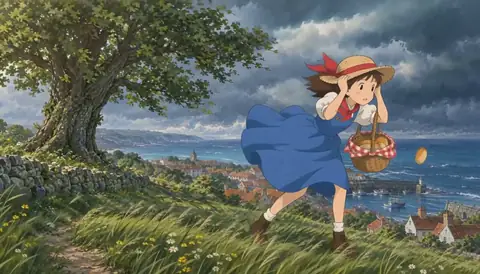 03Problem: the gustA storm wind pulls at Mio's straw hat as she holds on to her basket.
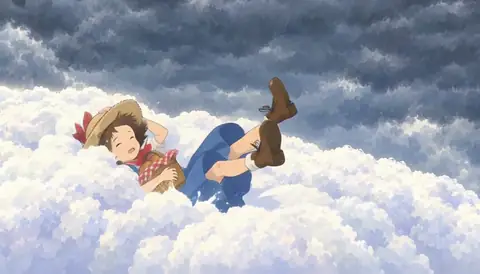 04Rescue: a soft landingMio falls toward the storm, and the whale catches her on its cloud back.
 05Vista: the sea of cloudsThe whale glides over a golden sea of clouds at sunset with Mio on its back.
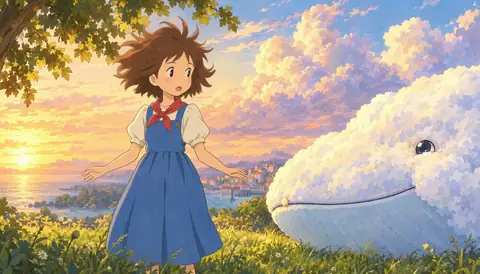 06Button: That was my hatSafe on the hill, a messy-haired Mio looks at the smiling whale. Her hat is gone.
Notice what is missing: no opening song and no preview. A short episode keeps the hook, the turn and the last image, and spends its seconds there.
A free template for a 3 minute episode
Copy it, change the brackets and paste the result into the idea box in Ziztu.
EPISODE [number]: [title]
0:00 HOOK (15 s): [the strangest or most dramatic image of the episode, in one shot]
0:15 TITLE CARD (3 s): [series title over a background of the world]
0:18 PART A (60 s): [who she is, what she wants, what goes wrong; end on the first turn]
1:18 BEAT (3 s): [a quiet image: sky, street, hands; the eyecatch]
1:21 PART B (85 s): [the problem gets worse; one rescue or one reveal; the payoff]
2:46 LAST IMAGE (10 s): [one image that asks a question]
2:56 TEASE (4 s): [three cuts of the next episode, no sound explaining them]
CAST: [two or three characters, with a look line for each]
LOOK: [one style line used in every shot]
Cost: free to copy. The structure follows the TV episode in a smaller form.
Start this in Ziztu
Start a short anime episode from one idea.
A 16:9 anime drama, episode 1: Noa, a first-year student, finds a love letter in her new desk written to the student who sat there before. It opens on an envelope in a drawer and ends on her own name written inside the flap.
40 free credits, no card: write the script, cast your characters, draw the storyboard and hear the voices. Video starts at $12. You see the price before every generation.
Keep going
- AI anime dramas the hub.
- Anime story ideas for 50 premises.
- AI anime series maker to plan a season.
- Anime script template to write the episode.
- Anime storyboard template to plan the shots in ekonte form.
- How to make an anime opening with AI if you want an opening sequence.
Sources (read 15 October 2026)
- Wikipedia, Animated series (the Television section) (read 15 October 2026; used for half-hour episodes, programme time once adverts are counted, very short episodes in Japanese animation)
- Wikipedia, Television in Japan (the cours section) (read 15 October 2026; used for a cour as a three-month period of usually 13 episodes, with its own opening and ending)
- Wikipedia, Eyecatch (read 15 October 2026; used for eyecatches of two to six seconds that begin and end a commercial break)
Platform rules and market figures change often. Check the source before you rely on a number.
Frequently asked questions
What is the structure of an anime episode?
A TV anime episode usually has a cold open, an opening song, a first half, an eyecatch, a second half, an ending song and a next-episode preview, in a half-hour slot. A short AI episode keeps what each part was for: a hook, a problem, a turn and a last image.
How long is an anime episode?
Traditionally half an hour or nearly, and Wikipedia says the programme itself may be only 15 to 20 minutes of that once adverts are counted. It also notes that very short episodes of about five minutes have recently become more common in Japanese animation. An AI anime episode is usually one to ten minutes.
What is an eyecatch in anime?
An eyecatch is a short scene or picture, usually two to six seconds long, used to begin and end a commercial break, often at a climax. It is made by the production company as part of the episode. A short AI episode can use a title card or a quiet beat in its place.
How many episodes are in a cour?
Wikipedia describes a cour as a three-month period of Japanese television, usually of 13 episodes, with its own opening and ending sequence and song. A short AI series of six to twelve episodes is a good size to finish.
How long should an AI anime episode be?
One to three minutes for a first episode. At list price a 1 minute episode of 15 shots of 4 seconds costs about $7.20 for the clips on Starter, and Ziztu shows the price of each clip before you generate it.
Is there a free anime episode template?
Yes. The template on this page plans a 3 minute episode with timestamps for the hook, a title card, two parts, a beat, a last image and a tease. Copy it and change the brackets.