Save the Cat Beat Sheet Generator
Type your logline, pick a genre and a length, and get the fifteen beats with the pages they belong on. Edit every beat, download the sheet, or let AI draft a first pass.
Updated
Example outputs
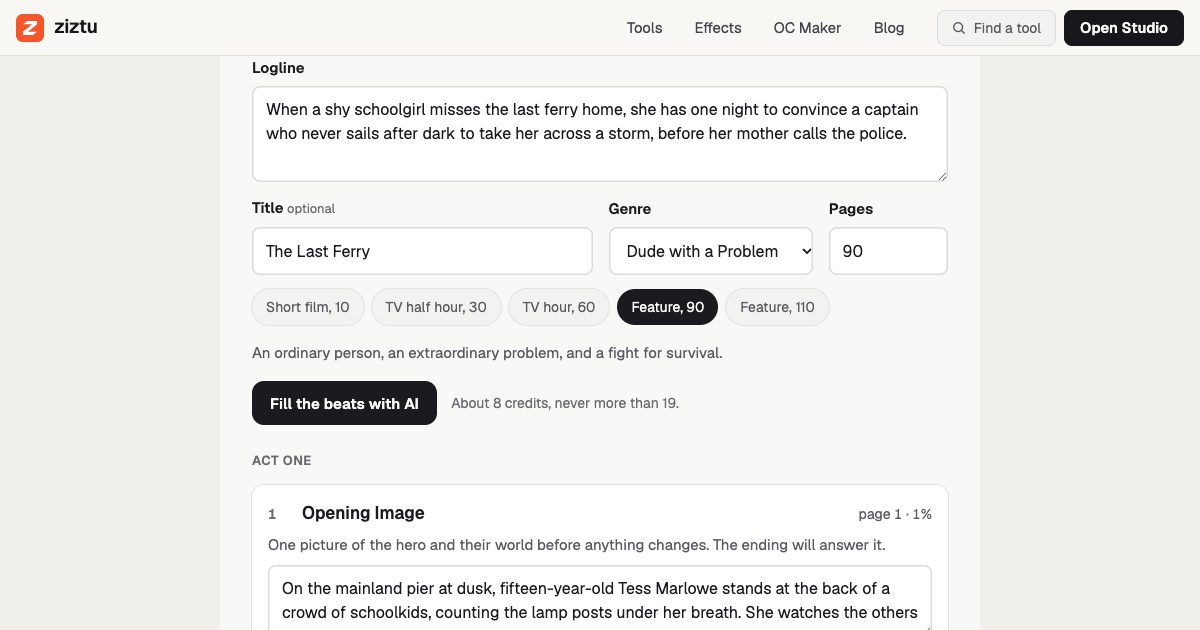
The sample logline at 90 pages: the opening image on page 1, the catalyst on page 10, the break into two on page 20
How it works
Write your logline: who wants what, and what stands in the way. Pick one of the method’s ten story genres if you know it, and the length of your script.
The fifteen beats appear with the pages they belong on for that length, from the Opening Image on page 1 to the Final Image on the last page, each with what it does and a note for your genre.
Write what happens in your story under each beat, or let the AI fill draft them from your logline. Download a PDF or Fountain notes, or open the sheet in the AI Script Writer as your outline.
Ideas and uses
| Beat | 90 pages | 110 pages | 120 pages |
|---|---|---|---|
| Opening Image | 1 | 1 | 1 |
| Theme Stated | 4 | 5 | 5 |
| Set-Up | 1 to 8 | 1 to 10 | 1 to 11 |
| Catalyst | 10 | 12 | 13 |
| Debate | 10 to 20 | 12 to 25 | 13 to 27 |
| Break into Two | 20 | 25 | 27 |
| B Story | 25 | 30 | 33 |
| Fun and Games | 25 to 45 | 30 to 55 | 33 to 60 |
| Midpoint | 45 | 55 | 60 |
| Bad Guys Close In | 45 to 61 | 55 to 75 | 60 to 82 |
| All Is Lost | 61 | 75 | 82 |
| Dark Night of the Soul | 61 to 70 | 75 to 85 | 82 to 93 |
| Break into Three | 70 | 85 | 93 |
| Finale | 70 to 90 | 85 to 110 | 93 to 120 |
| Final Image | 90 | 110 | 120 |
What a beat sheet is for
A beat sheet is the skeleton of a story before the scenes exist: fifteen moments every satisfying movie tends to hit, in the order they come, with roughly where each one lands. Writers use it to find the shape of an idea in an afternoon, to check a draft that feels flat, and to pitch a story in five minutes.
The method comes from Blake Snyder’s screenwriting books. It is a guide, not a law: a beat can come a few pages early or late, and the best scripts bend it. What matters is that each beat does its job: the catalyst really breaks the old life, the midpoint really raises the stakes, and the final image really answers the first one.
The page numbers, for any length
The method was written for a 110 page feature. This generator scales it to your script: a 90 page comedy, a 120 page drama, a 30 page pilot or a 10 page short. Each beat keeps its share of the story, so the catalyst lands about a tenth of the way in, the break into act two about a fifth, the midpoint at half and the break into act three at about four fifths.
- One page beats (the Catalyst, the Midpoint, All Is Lost) are moments: a single scene or even a single line.
- Long beats (the Set-Up, Fun and Games, Bad Guys Close In, the Finale) are stretches of several scenes.
- In a short film several beats share a page. That is normal: some become one shot.
The ten story genres
The method sorts stories by what they are about, not by their setting. Pick the one that fits your logline and the turning beats get a note for that kind of story.
- Monster in the House: A monster, a house the heroes cannot leave, and a sin that let it in.
- Golden Fleece: A road, a team and a prize, where the journey changes the hero more than the prize does.
- Out of the Bottle: A wish or a curse comes true, and the hero has to learn to live without the magic.
- Dude with a Problem: An ordinary person, an extraordinary problem, and a fight for survival.
- Rites of Passage: A life problem everyone goes through: growing up, grief, a break-up, a middle-age crisis.
- Buddy Love: Two people who complete each other, at first at odds, who need each other to become whole.
- Whydunit: A detective, a secret and a dark turn: the question is why, not who.
- Fool Triumphant: An underestimated hero, an establishment that looks down on them, and a fool who wins.
- Institutionalized: A group, a choice between the group and the self, and the cost of either.
- Superhero: A hero with a gift, a world that does not understand them, and an opponent who mirrors them.
From beats to pages
Download the sheet as Fountain notes and open it in any screenwriting app that reads Fountain: each act and beat becomes a section with your text as its synopsis, an outline that never prints. Or open it straight in the AI Script Writer, write the scenes under each beat, and ask the AI Script Doctor where the draft drifts from its beats.
Frequently asked questions
Is the beat sheet generator free?
Yes. The beats, the page numbers, editing and the PDF and Fountain downloads all run in your browser for free with no account. Only the optional AI fill needs an account, and its price in credits shows before you use it.
What are the 15 Save the Cat beats?
Opening Image, Theme Stated, Set-Up, Catalyst, Debate, Break into Two, B Story, Fun and Games, Midpoint, Bad Guys Close In, All Is Lost, Dark Night of the Soul, Break into Three, Finale and Final Image.
What page should the catalyst be on?
About a tenth of the way in: page 12 of a 110 page script, page 10 of a 90 page script and page 3 of a 30 page pilot. The generator works it out for your length.
Does it work for TV pilots and short films?
Yes. Set the page count and the beats scale with it. In a very short film several beats share a page, which usually means one shot or one line carries them.
What does the AI fill do?
It drafts one to three sentences for each beat from your logline, genre and length, and keeps any beat you already wrote. Treat it as a first pass to rewrite in your own words.
Is my beat sheet uploaded?
No. It stays in your browser. Only the AI fill sends your logline and beats to our server, and opening the sheet in the studio saves it to your account.